What Is Mouse Weight and Why Does It Matter for Gaming?
What Is Mouse Weight and Why Does It Matter for Gaming?
Ever picked up a friend’s mouse and thought, “whoa, this feels like nothing”? Or the other way round, and it felt like you were dragging a brick across the desk? That feeling is mouse weight, and it changes how a mouse behaves in your hand more than most people expect.
It’s also one of the most argued-about topics in gaming gear. Let’s sort out what’s real and what’s just hype.
The Short Answer
It’s how heavy the mouse is, measured in grams. Light mice start and stop easily. Heavy ones need a bit more push and then feel steady.
Which is better? Depends on you. I know that’s a boring answer, but it’s the true one.
Quick Breakdown Table
Nobody has an official line, and every guide draws it somewhere else. Here’s a rough version:
| Weight | How people usually describe it | Who often likes it |
|---|---|---|
| Under about 50g | Ultralight, almost floaty | People who want the least effort, mostly fast shooter players |
| About 50 to 70g | Light and quick off the pad | Competitive FPS players, big flickers |
| About 70 to 90g | The middle ground, steady but not slow | A lot of all-round gamers |
| 90g and up | Heavier, feels planted | Casual play, MMOs, anyone who likes a solid mouse |
The guides do not even agree with each other. One says competitive players sit around 55 to 75g. Another says low-sensitivity players often go for 70 to 90g. Two articles, two answers. Fine. That tells you it’s personal.
What It Looks like on Real Mice
The numbers below come from the makers and retailers. We did not weigh these ourselves.
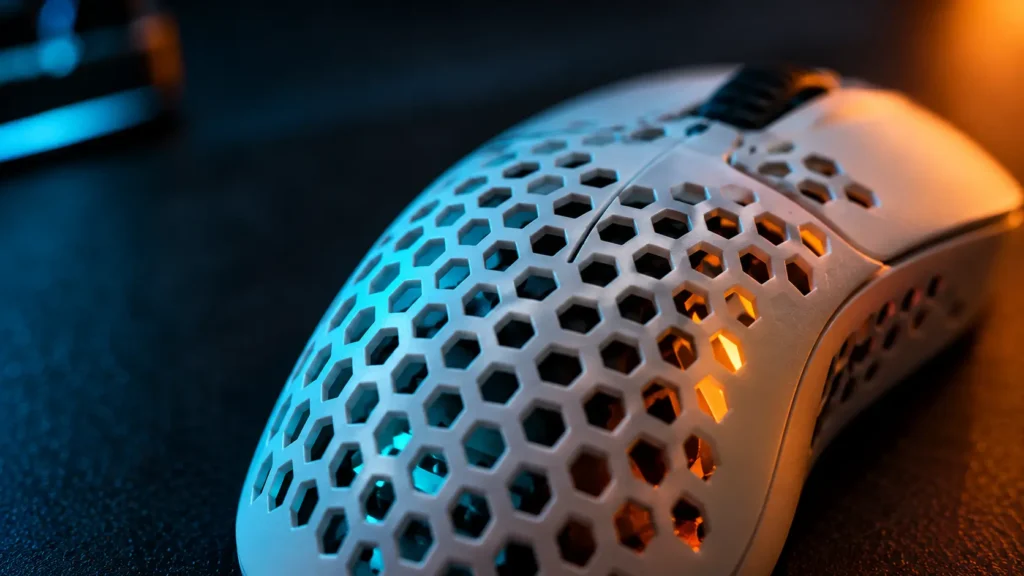
The Razer Viper V3 Pro is listed at 54g. That’s very light. The SteelSeries Aerox 5 Wireless is 66g, and SteelSeries says the honeycomb shell takes out up to 20g. The Logitech G502 X is listed as down to 89g, which is a decent diet for a mouse covered in buttons. Then the Razer Basilisk V3 Pro 35K, listed at 112g. A retailer calls it comparatively heavy, and we would agree.
Lightest to heaviest is about double. You would feel that.
How Weight Changes the Way a Mouse feels
Think of an empty shopping trolley and a full one. The empty one goes wherever you flick it. The full one takes effort, but it does not wander.
Light mice feel snappy, so small quick moves are easy. Heavier mice have more inertia, and some players like that for tiny adjustments or for holding a crosshair still. That’s about as far as the evidence goes, as far as I have seen. Your sensitivity, mousepad, grip and sensor all muddy the picture.

Does a Lighter Mouse Really Tire You out less?
It could be. At low sensitivity you are swinging your whole arm for hours, so moving less mass probably feels easier by the end.
Probably. I would not bet on it. The “less weight, less fatigue” slogan shows up in maker pages and I have not found solid testing behind it. A few people also say very light mice feel twitchy when tracking. If your hand actually hurts, look at shape and fit first. What makes a good gaming mouse is the place to begin.

Balance can Matter More than the Number
Spec sheets skip this. Where the weight sits is a huge deal. A balanced 75g mouse can feel better than an awkward 65g one.
Weight too far back and the front feels vague. Too far forward and it feels nose-heavy. You only find out by holding it. Grip matters here too, because palm, claw and fingertip all load a mouse differently. A shape that’s lovely in one grip can feel wrong in another.
Other Things that Change How Heavy a Mouse feels
A few things fool you into thinking it’s the grams.
Mousepad first. Smooth pads make a light mouse slide further, and a rougher pad calms it down. Cables next. A stiff cable on a wired mouse can matter more than a few grams. On wireless, the battery and internal layout shift the balance. And sensitivity decides how far your hand moves in the first place. Our CPI guide explains that part.
So, Which Weight should You Pick?
Fast shooters, lots of flicking? Start around 50 to 70g. Like control, or play at low sensitivity? Try 70 to 90g before going ultralight.
MMO, strategy or casual? Stop chasing small numbers. A heavier mouse with plenty of buttons is a fine choice, and lots of people love the solid feel. Bigger hands usually do better on bigger mice anyway, and those weigh more.

How to Find Your own Weight
Keep sensitivity, pad and game identical. Change only the mouse. Give it a few sessions, because hour one always feels strange.
Then watch what’s going wrong. Overshooting? Try a little more weight. Cannot flick fast enough? Go lighter, or check sensitivity first. Write down what you notice after each session. Boring, yes. It keeps gut feeling from running the show. Our testing guide has simple routines you can borrow.

What Our Team saw
Our team tested the Razer Basilisk V3 Pro and Logitech G PRO X2 SUPERSTRIKE during actual gaming, and the weight difference changed everything. The 61-gram Logitech SUPERSTRIKE feels incredibly light and allows for instant, sharp flicks during intense matches without any resistance. In contrast, the 112-gram Razer Basilisk is much heavier, which actually helps with smooth, steady tracking at long distances but slows down your quick reactions.
When it comes to hand fatigue, the lighter Logitech mouse easily wins for long gaming sessions. The heavy build of the Razer Basilisk puts a lot of strain on your wrist and forearm, causing muscle tiredness after just a couple of competitive matches. The Logitech SUPERSTRIKE glides effortlessly, keeping your movements highly responsive and your hands completely pain-free even after hours of continuous play.
Mistakes to Avoid
Buying the lightest mouse because a list said so. Judging a mouse after ten minutes. Blaming weight for every miss when it might be sensitivity, the pad, or a double-click problem. Our double-click guide covers that last one.
One more trap, and it’s an easy one to fall into. Switching to a new mouse and then changing your sensitivity, your pad and your grip all in the same week. Then something feels better, or worse, and you have got no idea which change did it. Also, do not ignore size just because a weight number looks great. A 55g mouse that’s too small or too big for your hand will feel worse than a heavier one that fits, no matter how good the spec sheet looks.
Final Verdict
Mouse weight is how heavy your mouse is. It changes how easily the mouse starts, stops and holds steady. Light ones feel quick, heavy ones feel planted, and neither wins every time.
My one tip: fit first, grams second. A well-shaped 80g mouse beats an ill-fitting 55g one nearly every day. Still deciding? Our beginner buying guide keeps it simple.
Frequently Asked Questions (FAQs)
Everything on this page comes from our team’s own experience, along with feedback from Amazon buyers and other verified users. We try to be straight about what we have seen, but experiences differ, and something that felt great to us would not necessarily feel the same to you. Fit, feel and habits are personal, so treat our advice as a starting point, not a promise.
We also pay attention to what real owners keep saying, not just what a spec sheet promises. If something looks great on paper but users keep flagging the same issue, we will mention it.
15 Responses